

The surgery involves cooling the child’s body to 16 degrees Celsius and temporarily stopping the circulation to all the organs for 30 to 40 minutes to do the corrective operation with a prosthetic graft.
Chennai, November 17, 2026:
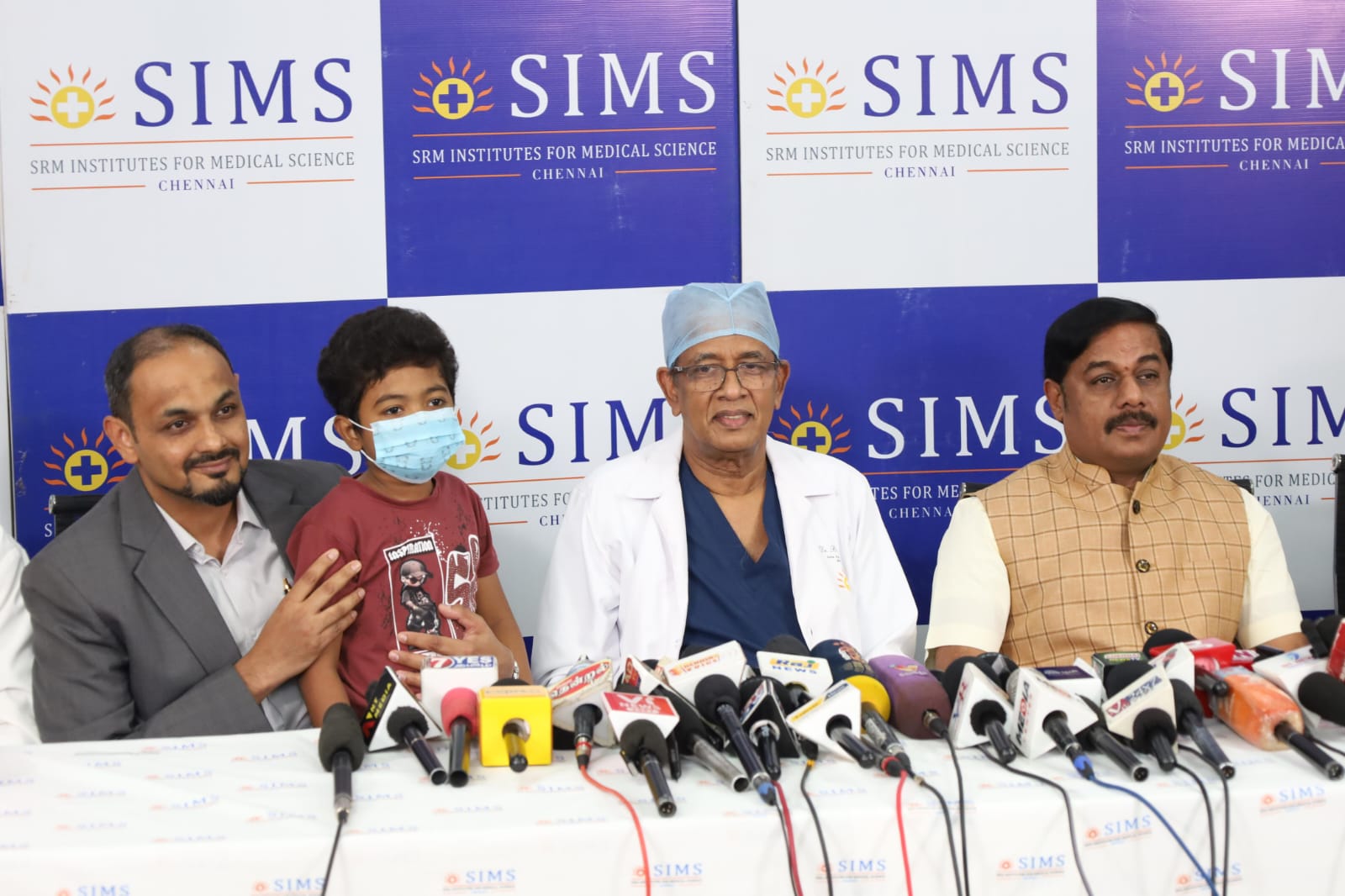
In a major achievement, SIMS Hospital has performed Asia’s first largest aortic aneurysm surgery in the youngest patient for aortoarteritis.
This child was referred to us in a critical condition with breathing difficulty and increase in the heart rate, called palpitation. He was not able to lie down and sleep properly and surgery had to be done as a semi-emergency as bursting of this aneurysm can be fatal. His largest blood vessel aorta was so enlarged that we could see the pulsations on the chest wall, which was frightening for anyone.
So as soon as we saw the child, we did all the necessary tests and found that he has a large aneurysm of thoracic aorta, and the disease was diagnosed as aortoarteritis or otherwise called Takayasu arteritis. In this condition, the blood vessels become thickened and enlarged (aneurysmal) at times. Since the disease was active, we referred the child to the rheumatology department to prepare him for surgery.
When there is inflammation in the blood vessel, surgery carries a very high risk of bleeding and is technically difficult. So, we had to put him on medicine to prepare him for the operation, otherwise surgery will be highly risky. Takayasu arteritis as we call it is very rare in children and this is the youngest patient we have seen in our experience with aortic aneurysm surgery for close to 40 years.
Surgical procedure, since this bulge in the aorta (aneurysm) was very close to the breastbone, opening the chest in the usual way, can be fatal due to injury of the aorta. Because of this, we had to first connect the child to the heart-lung machine by making a hole in the artery and vein in the groin. We had to use very small tubes since the child was only about 18 kilograms.
Then we cooled the child to about 16 degrees Celsius, we call it deep hypothermic circulatory arrest. We give medicines to stop the heart, then stop the circulation to the whole body for about 40 minutes. During this time, we open the aorta and repair it with a Dacron graft, which is a Dacron cloth tube.
We stitched it and then replaced the aneurysm and repaired it. Once the repair was complete, we warmed the patient to normal body temperature with the heart-lung machine and disconnected the patient from that machine. After this, the patient was shifted to the ICU, and he recovered very well and was discharged in a very good condition on the 9th day.
He is a different child than the parents and resumed normal activities. He is able to walk without any problem, with no breathing difficulty and sleep comfortably.
However, he needs to take medicines to prevent further progression of the disease and development of aneurysm in other parts of the aorta.
The surgery was performed by a team of surgeons led by Dr Bashi V. Velayudhan, Cardiothoracic Surgeon, along with Dr. Mohammed Idhrees, Senior Consultant, Cardiothoracic Surgery with anaesthetic support from Dr. Aju Jacob, and Dr. Arun Kumar, Senior Consultants, Anaesthesiology. The other members of the team included scrub nurses to assist during surgery, Perfusionist to operate the heart lung machine, theatre technician to help the anaesthesiology team.
In his comments, Dr. Bashi V. Velayudhan, Director / Senior Consultant, Cardiothoracic Surgery said, “We are happy that we could successfully save this child, who presented with this extremely rare and life-threatening condition. Replacing the ascending aorta and aortic arch in a child is highly challenging – as one of the most critical aspects of the operation was temporarily stopping blood circulation to allow us to remove the diseased portions of the aorta and replace them with a graft. To protect vital organs such as the brain, kidneys, intestines and spinal cord during this period, we cooled the child’s body to 16°C using a cardiopulmonary bypass machine. This significantly reduces the body’s metabolic activity and, consequently, its oxygen requirement, allowing vital organs to withstand the temporary interruption of blood supply. Blood circulation was temporarily stopped for about 40 minutes while we performed the aortic reconstruction, after which circulation was carefully restored”
Dr. Mohammed Idhrees, Senior Consultant, Cardiothoracic Surgery, SIMS Hospital, said, “This is a proud moment for cardiothoracic surgery and a testament to the surgical expertise of our team. What the team has achieved is no small feat. Blood circulation was stopped for about 40 minutes while the surgeon performed the delicate aortic reconstruction, following which circulation was carefully restored. . It is somewhat like having to shut off the water supply to an entire house to repair a major plumbing problem. In this case, we had to temporarily stop the body’s blood supply while ensuring that the vital organs were adequately protected throughout the procedure. Post-surgical tests have confirmed that there was no damage to vital organs, including the brain, kidneys, intestines and spinal cord, during this period. The reconstructed aorta and its branches are also functioning well. Considering the complexity of the procedure and the child’s young age, this is an exceptional outcome.”
Dr. Arun Kumar, Senior Consultant, Anaesthesiology, added that “Anaesthetising the child posed additional challenges. His blood pressure was significantly elevated and difficult to control before induction of anaesthesia, increasing the complexity of the process. Furthermore, given his small body size and the possibility of steroid-related tissue changes following preoperative treatment, securing the airway and endotracheal intubation could also be technically challenging”.
Speaking on the achievement, Dr. Ravi Pachamuthu, Chairman of SRM Group, “We are extremely happy and proud to have achieved this significant surgical milestone. This achievement reflects SIMS Hospital’s commitment to advancing the boundaries of medical care and bringing highly specialised, complex treatments within reach of patients who need them. Successfully performing this rare and complex procedure in a child, and achieving a first for Asia, is a testament to the expertise, dedication and collaborative efforts of our medical teams. We remain committed to pushing the frontiers of medical science and delivering the best possible outcomes for our patients, particularly in cases where treatment options are limited.”